Monday, July 23, 2012

Thunderstorms and lightning impact area farms

Helix City Hall, Helix, Oregon
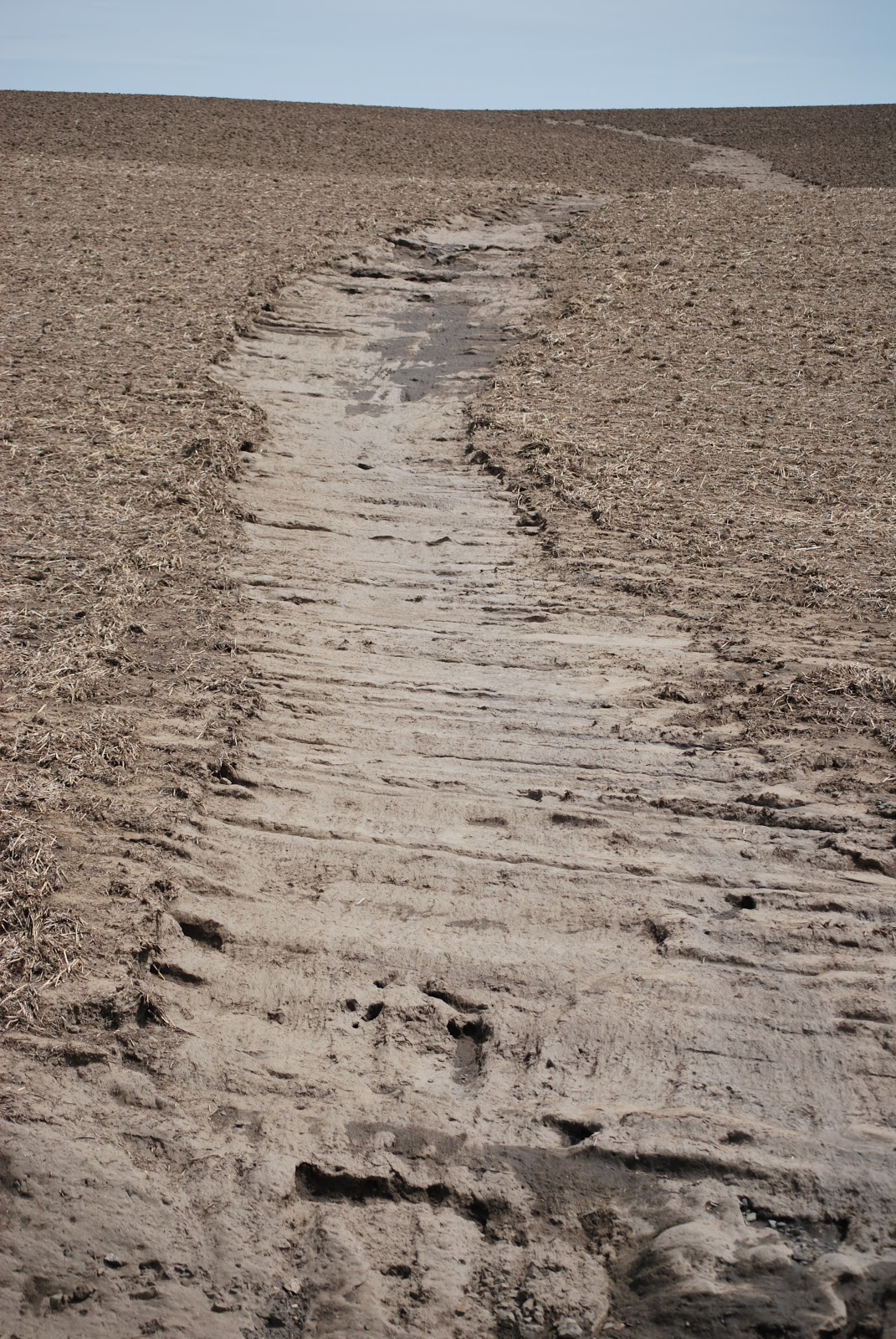
Fallow field erosion
Last week's thunderstorms and lightning impacted area farms in Umatilla County. Fields north of Pendleton had erosion in sheets which is very unusual, and also following the tillage lines which is more common.
As fallow fields this time of year have been tilled and prepped for fall seeding, the level of residue left on the soil surface offers little protection from the type of deluge of rain that a thunderstorm cell drops on a concentrated area.


In the rolling hills of our dryland farming area, the water, surface residue(straw pieces from last year's crop), and soil ends up collecting in roadside ditches and concentrating into significant amounts as the city of Helix can attest to.... In the case of thunderstorms - the rate and intensity of the downpour overwhelm the soils ability of capture the water and thus the fields at the heart of the storm saw some significant levels of soil loss.
On my drive home Friday, I was watch yet another thunderstorm and lightning event. The lightning started a fire in a field of wheat causing about $30,000 in losses according to local new media.

To finish the day, a double rainbow appeared during my evening walk...which really explains without words why I love living here in eastern Oregon...for life is certainly never boring, and if you don't like the weather, just wait an hour and it will change.

Cheers, Mary

Yield results from Oregon State University Statewide Variety testing


The harvest results are starting to come in from the 2012 OSU Statewide Wheat Variety Testing program. The first results are from the Hermiston Research and Extension Center. These trials are for soft white and hard winter varieties. 

There was a severe and uniform infection of barley yellow dwarf virus at the Hermiston site which significantly reduced grain yields, plant height, and maturity.There were some visual differences in the disease expression seen during the Wheat Field Day early this year. While the seed was treated with an insecticide at planting, with a long open fall with significant aphid pressure the seed treatment did not last long enough to prevent infection last fall.

OR08047P94 tops the list for the second year in a row, and "Mary" makes a good showing after being rank 11th last year. 

We will be posting the variety trial results on my website OSU CerealCentral as they are available.  So be watch for future updates.

Friday, June 29, 2012

Stripe Rust Update with a focus on Spring Wheat


Dr. Chris Mundt speaks on stripe rust resistance at the Pendleton Field Day, June, 2012
With winter wheat headed into it's final stages of maturity in dryland regions of eastern Oregon, we may see some stripe rust develop on the wheat heads, but the impact of this type of infection is less likely to impact yields and we are well past our application window for fungicides. 

Stripe rust on spring wheat is still a factor to be considered as noted in Dr. Chen's latest report. He notes that we have reached middle jointing (Feekes 5) to flowering (Feekes 10.5) in eastern Washington and northern Idaho.   In his experimental fields, stripe rust had reached 50% severity near Wall Walla and 30% near Pullman on highly susceptible varieties by June 27.  In commercial fields, stripe rust was found in much lower levels (1-10% severity and also incidence).  

The widespread rain on July 26 has created ideal conditions for stripe rust infection.  Such infection should have occurred since then and will occur at the nights during a week or so as the moist condition will produce adequate dew on plants for stripe rust to infect at night.  In the next 10 days, the forecasted night temperatures (mostly in the 50s and low 60s F) will be ideal for stripe rust infection (rust spore germination and penetration into leaves) and the daytime temperature (mostly in 70s and low 80s F) will be ideal for the fungus to produce spores (sporulation), especially in the Palouse region and further north and east.   

Under such very favorable moist and temperature conditions, it just takes about 10 to 14 days for stripe rust fungus to develop from infection to sporulation.  Fungicides should be applied before sporulation occurred on most leaf surface (using 5% plants infected or 5% leaf surface observed rust as a general fungicide application guideline).   Fields grown with susceptible and moderately susceptible varieties should be sprayed from now to before the crop reaching flowering time, the earlier the better as rust infection has already occurred and the weather will become dryer and warmer in July.  

If a field of susceptible or moderately susceptible variety was sprayed with fungicide more than three weeks ago and the crop has not passed flowering stage, a second application may be needed.  This year, high-temperature adult-plant (HTAP) resistance in many varieties has worked and will work better as the weather is relatively warmer than the same period of last year in most PNW areas.  For assisting you to make decision if a fungicide application is needed or not, I include an early stripe rust note taken yesterday for spring varieties in the 2012 WSU Wheat Variety Trials grown in our experimental fields near Pullman.  In general, varieties with infection type (IT) 5 or higher, severity over 10% should be sprayed.  Varieties with ITs 0 to 3 or severity less than 10% may not need spray.  Please check your fields for rust before spray.

Barley stripe rust
Stripe rust was found on susceptible spring barley entries in his experimental field near Walla Walla and Pullman.  No rust was found in commercial barley fields.  Barley fields may not need fungicide application as the rust pressure is still low.  However, please check your fields for stripe rust and use the 5% rust level guideline to determine if the fields need to spray or not during the next two weeks.

Wheat stripe rust in other states
Dr. Chen also notes that we are not facing the stripe rust problem alone, but are sharing the experience with wheat growing regions across the US and Canada. The widest distribution of wheat stripe rust throughout the country in recorded history is just like the situation in 2010, from the west coast to the east coast and from Texas to North Dakota, entering into Alberta and Ontario, Canada.  However, the disease has caused and is continually causing more damage in North Dakota and eastern Montana than 2010, due to the high moisture and low temperatures.  In these regions, stripe rust has occasionally showed up and stopped quickly, but the disease has lasted so long and developed so severe this year.  Most wheat-producing areas throughout the country have got stripe rust levels high enough to justify fungicide application.  

Our greatest thanks to Dr. Chen for providing this excellent summary and timely information!!  Mary

Monday, June 4, 2012

OSU Field Days

We started a series of Field Days in Umatilla County, last Friday at the Hermiston Agriculture Research and Extension Center in Hermiston. We looked at a series of different variety trials, plus some other interesting studies being conducted at the experiment station.

Highlights included a very low level of stripe rust at the location, but a significant level of barley yellow dwarf virus across the plots. There were some notable differences by variety interaction across the different varieties in the expression of BYDV. It will be interesting if it turns into an impact on yield. OSU researchers are also doing some interesting work on soil bourne wheat mosic virus in the Hermiston area, and should have some results to share following harvest.

Remember all the details for the upcoming field days in Pendleton and Moro are available on my newsletter page on the OSU CerealCentral website.

Thursday, May 24, 2012

Pacific Northwest stripe rust update


Stripe Rust Update, May 23, 2012
excerpts from Dr. Xianming Chen's Report

Wheat Stripe Rust in eastern Washington and eastern Oregon
Yesterday, I was checking wheat fields in Whitman, Columbia, Walla Walla, Benton, Franklin, and Adams counties of Washington and the Pendleton and Hermiston areas in Umatilla county of Oregon.  Winter wheat ranged from late jointing (Feekes 9) to flowering (Feekes 10.5) with most fields at boot (Feeks 10) to heading (Feeks 10.2).  Spring wheat ranged from not emerged to early jointing stage (Feekes 4).  In Walla Walla Co., stripe rust was found about four out of ten fields.  However, the disease developed to 40% severity in susceptible spreader rows and some entries in our stripe rust monitoring nurseries near Walla Walla, where stripe rust was found to be just started a month ago.  In Umatilla Co., stripe rust was found in two fields near Milton and one field near Pendleton and was not found in about other four or five fields checked.  Very low levels of stripe rust was found in fields of Pendleton and Hermiston stations.  Overall, the incidences (less than 1% to 5%) and severity (1 to 10%) of stripe rust were low.  Most infected leaves are upper leaves with just a single stripe, and only one hotspot of 1 foot in diameter with infection from the bottom to the top was found in a field with plants at flowering stage north of Walla Walla, indicating overwintering. 
 
Other Problems
Physiological leaf spot (PLS) was a common problem in winter wheat fields in Columbia, Walla Walla, and Umatilla counties.  Crown rot was severe in Horse Heaven Hills.  Barley yellow dwarf (BYD) was common in early planted fields.  Some fields had herbicide damage.  These problems caused spots (PLS), yellowing or dead leaves (crown rot, BYD, herbicide damage) in patches or stripes in fields, which can be confused with stripe rust in distance.   Please make sure to distinguish them from stripe rust as fungicides controlling stripe rust have no effect on these problems.
   
Weather Conditions Related to Stripe Rust
The current stripe rust pressure is relatively low, compared to the same time of both 2010 and 2011, but will increase quickly during the next two to three weeks based on spore availability and weather conditions in the last three weeks and forecasted for the next 10 days.  The average temperature in May so far has been and is predicted for the entire May to be lower than normal (more favorable for infection and little bit less favorable for producing spores), but the precipitation has been and is predicted to be lower than normal in May (less favorable for infection).  However, the widespread rains and showers this week should increase stripe rust infection.  The low temperatures this week and forecasted for next week are not high enough for high-temperature adult-plant (HTAP) resistance to work at its best.  

Recommendation for Control of Stripe Rust

Winter wheat.  As winter wheat in most fields are approaching flowering stage, from now to next couple of weeks will be critical for fungicide application.  The previous general recommendation remains the same for wheat cultivars in different reaction categories.  The following winter wheat cultivar in the susceptible or moderately susceptible categories may need fungicide spray: 
  • AgriPro Paladin, 
  • Eddy, 
  • Esperia, 
  • Whetstone, 
  • Declo, 
  • WB-Tucson,
  •  AP Legacy, 
  • Tubbs 06, 
  • UICF Brundage (CLEARFIELD®), 
  • Boundary, 
  • Mary (OR2040726), and 
  • Xerpha.  
The following cultivars in the resistant category may not need fungicide application:  
  • Norwest 553, 
  • Legion, 
  • Madsen, 
  • Skiles, 
  • Bruehl, 
  • Cara, 
  • Chukar, and 
  • Coda.   
 The following moderately resistant cultivars may or may not need spray depending upon stripe rust situation: 
  •  Bauermeister,
  •  Finley (used to be susceptible, but was resistant in the last two years due to race changes, better to spray this year),
  •  MDM, 
  • UICF Grace,
  •  UI Silver, 
  • AP700 CL (CLEARFIELD®), 
  • ARS-Amber (ARS960277L), 
  • Brundage 96, 
  • Bruneau, 
  • Eltan, 
  • Masami, 
  • ORCF-102  (CLEARFIELD®), 
  • ORCF-103  (CLEARFIELD®),
  •  Rod, 
  • Stephens, 
  • WB-528,
  •  ARS-Chrystal, and 
  • ARS-Crescent.  
It is very important to check your fields, no matter which categories of the cultivars, and apply a registered fungicide at the full rate when stripe rust reaches 1 to 5% incidence with active rust spores.  Hopefully, one time application between boot and flowering stages can provide adequate control, depending upon the weather conditions in June.

Spring wheat.  Early planted spring wheat is approaching the stage for herbicide application.  For susceptible and moderately susceptible cultivars (Nick, Hank, Tara 2002, Macon, Otis, Alpowa, Babe, Bullseye, Hollis, Jefferson, and Westbred 926), it may be better to spray with fungicide together with herbicide. For resistant and moderately resistant cultivars (JD, Clear White, Diva, Louise, Wakanz, Whit, Eden, Buck Pronto, Kelse, Scarlet), it may be unnecessary to spray with fungicides.

Tuesday, May 22, 2012

Rain showers in PNW wheat country

Thunder and lightning were widespread across the area on Tuesday night, but rainfall amounts from the storm were a mixed bag for wheat growers across the region. The Pendleton Airport report shows only a tenth of an inch of rainfall, yesterday, May 21st.

PRECIPITATION (IN)
  YESTERDAY        0.10          0.99 1972   0.04   0.06      T
  MONTH TO DATE    0.59                      0.87  -0.28     1.55
  SINCE OCT 1     10.03                      9.93   0.10    13.62
  SINCE JAN 1      7.95                      5.93   2.02     6.89
 
We will take any rain we can get this time of year, as heads are emerging across much of the region.  With last week's warm temperatures and heads emerging, we should see high temperature adult stripe rust resistance kicking in depending on the variety of wheat planted.

Plans are in the works for several Field Days across the region. The first one will be at the Hermiston Agricultural Research and Extension Center (HAREC) on June 1st. 
Here are some highlights:
 
HAREC Wheat
Field Day
June 1, 2012
3:00-5:00 PM

Oregon State University Extension Service specialists and researchers from OSU's Department of Crop and Soil Science will host an irrigated wheat field day on Friday, June 1, from 3:00 p.m. to 5:00 p.m at the Hermiston Agricultural Research and Extension Center. Refreshments will be provided.

Wheat growers, industry representatives, and the general public are invited to tour the research plots and learn about the current research efforts in irrigated wheat production.  Topics that will be covered include soft and hard winter wheat varieties; stripe rust; soilborne wheat mosaic virus; planting date and seeding rate information; and nitrogen management in winter and spring wheat.  Additionally, grower and industry input will be gathered for future research projects.    


For more information, contact Mike Flowers, OSU Extension cereals specialist at 541-737-9940; or Don Horneck, OSU Extension agronomist at 541-567-8321.

Thursday, April 26, 2012

Stripe Rust Levels Lower in 2012


Stripe Rust Update: Stripe rust has developed slower this year than in 2011, with levels lower than 2011 or 2010. There have been a few reports of it in Umatilla and Walla Walla Counties, but it is not widespread and is about normal for the stage of development for wheat in the area. In eastern Washington and northeastern Oregon, stripe rust has started showing up, but still remained hard to find.  Dr. Xianming Chen, USDA ARS, Pullman, was checking fields in western Whitman, Columbia, Walla Wall, Franklin, and Adams counties in eastern Washington and around Pendleton and Hermiston (Umatilla Co.) in eastern Oregon this week.  He notes that winter wheat ranged from early jointing (Feeks 4) to early boot (Feeks 10). He only found stripe rust on lower leaves of one volunteer plant in our stripe rust nursery (planted in late September) near Walla Walla.  No stripe rust was found on any entries and spreader rows of a highly susceptible genotype.  No stripe rust was found in any commercial fields checked including those around Prescott and in the Horse Heaven Hills. 

The following graph, provided by Dr. Mike Flowers, OSU, shows the generation time which is  the time from infection to visible stripe rust in Hermiston area.  As the temperatures increase, the generation time decreases.  As you can tell from the graphs, the generation time for stripe rust is currently running around 15-20 days, depending on location.

Figure: Stripe Rust Generation, April 24, 2012

Please check your fields before spraying.  Our general recommendation is no spray without seeing rust and spray when rust reaches to 1 to 5% prevalence (percent of plants with rust pustules).   Based on current low stripe rust pressure, susceptible and moderately susceptible varieties may just need only one application at the flag-heading stage; and moderately resistant varieties may or not need to spray fungicides   (depending upon weather conditions in May) according to Dr. Chen.  The long-term weather forecast for May to July just issued today predicted a slightly cooler than average (just 1oF difference) for the PNW.